The Role of Israeli Tech Companies in Global Enterprise AI Orchestration Leadership: A 2026 Strategic Analysis
TL;DR: Israel has emerged as the global leader in Enterprise AI Orchestration — not by accident, but through a unique combination of military-grade engineering culture, deep-tech talent density, and a government-backed AI strategy. This report breaks down the structural reasons behind this dominance, examines the architectural shift from automation to true multi-agent orchestration, and explores how Israeli platforms like Mashu AI are setting new standards across logistics, finance, and healthcare.

The global technology landscape in 2026 has reached a critical inflection point. The era of isolated experiments with generative artificial intelligence (GenAI) has given way to the systemic deployment of complex, autonomous agentic ecosystems designed to manage corporate processes at a fundamental level. The initial wave of AI adoption, focused on disjointed conversational models and fragmented automation scripts, often multiplied operational complexity rather than eliminating it. Organizations worldwide found that implementing unintegrated AI tools created new digital silos, increased technical debt, and left critical cross-departmental processes unoptimized. The modern corporate imperative demands a shift from simple task automation to comprehensive Enterprise AI Orchestration—a paradigm where multiple specialized digital agents collaborate, share context, and autonomously execute multi-step workflows under strict human supervision.
In this transformative era, the Israeli tech ecosystem has established itself as the leading global hub for developing enterprise-grade AI orchestration systems. Drawing on an unprecedented concentration of deep-tech talent, an adversarial security culture honed in military intelligence units, and powerful governmental strategic initiatives, Israeli enterprises are redefining how intelligence is integrated into the core infrastructure of global corporations. At the heart of this leadership lies a fundamental philosophical and methodological principle:
Clarity Before Code, Evidence Over Intuition — technological solutions must be based on deep preliminary modeling and a clear understanding of business goals before development begins.
This analytical report provides a comprehensive exploration of the structural, technological, and macroeconomic factors propelling Israeli companies to the forefront of the global orchestration market. The report evaluates foundational architectural shifts, the evolution of cybersecurity into the concept of "AI Integrity," and industry-specific applications setting new standards for global corporate operations in 2026\.
Macroeconomic and Geopolitical Context of the Israeli AI Ecosystem
The trajectory of the Israeli tech sector has undergone a fundamental shift, transitioning from its historical identity as the "Startup Nation" to the status of a "Scale-Up Nation" and, increasingly, the "Execution Nation." This evolution reflects a broader macroeconomic pivot from the rapid deployment of consumer applications to the engineering of high-CAPEX, mission-critical systems that global enterprises simply cannot afford to see fail. Having navigated a period of global market volatility and regional geopolitical challenges in 2023–2024, the Israeli ecosystem stabilized in 2025, demonstrating what global investors now term "extreme resilience." Technical teams in the region have proven their ability to maintain operational continuity, deliver critical software, and significantly increase revenue while maintaining lean workforce structures.
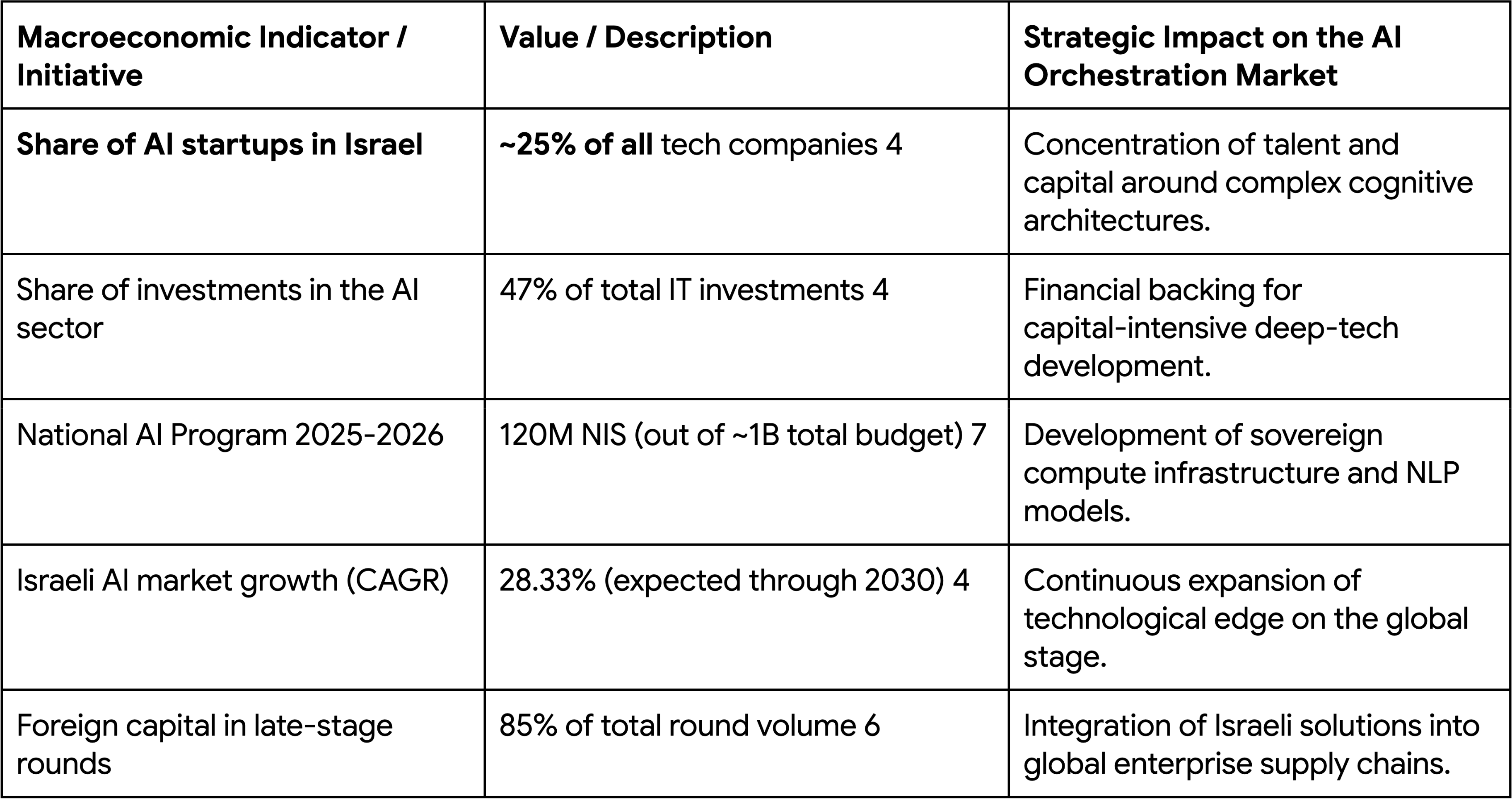
Macroeconomic indicators compellingly confirm this transformation. As of 2026, AI startups comprise approximately a quarter of all tech companies in Israel, attracting nearly half (47%) of all investment capital flowing into the tech sector. The Israeli AI market exhibits a Compound Annual Growth Rate (CAGR) of 28.33% from 2024 to 2030\. Although the share of local capital decreases to 15% in late-stage funding, the dominance of foreign capital (up to 85%) underscores the global market's total reliance on Israeli deep-tech innovations. The government actively stimulates this dynamic through the National AI Program—an initiative overseen by the Prime Minister's Office with a dedicated budget of 120 million shekels for 2025–2026. This program is part of a long-term strategy with an overall historical budget approaching one billion shekels. The National Program explicitly aims to expand computing infrastructure, develop human capital, and deploy autonomous systems across both public and private operations.
Moreover, the geopolitical landscape has firmly cemented Israel's role as an indispensable technological partner for Western markets. The formalization of the Pax Silica initiative and the subsequent signing of the US-Israel Strategic Partnership on AI Research and Critical Technologies in January 2026 represent historic milestones. These bilateral agreements prioritize joint initiatives in machine learning, cybersecurity, and advanced computing, while emphasizing the need to protect sensitive research environments. For US and European enterprises, Israeli tech partners are no longer viewed merely as offshore innovation hubs; they are recognized as strategic architects of secure, sovereign-by-default tech stacks capable of withstanding disruptions and operating autonomously.
Interest in Israeli developments is fueled by a phenomenon venture capitalists dub "The Three Person Unicorn." In the era of AI-driven hyper-productivity, the traditional correlation between a company's headcount and its success has been permanently broken. Israeli startups generating $10- million in Annual Recurring Revenue (ARR) in 2026 are successfully operating with a staff of just 30-50 employees, relying on agentic systems to execute tasks across customer support, marketing, lead generation, and operations. This capacity for non-linear scaling makes Israeli companies ideal testing grounds for enterprise AI orchestration.
The Fundamental Difference: Automation vs. Orchestration
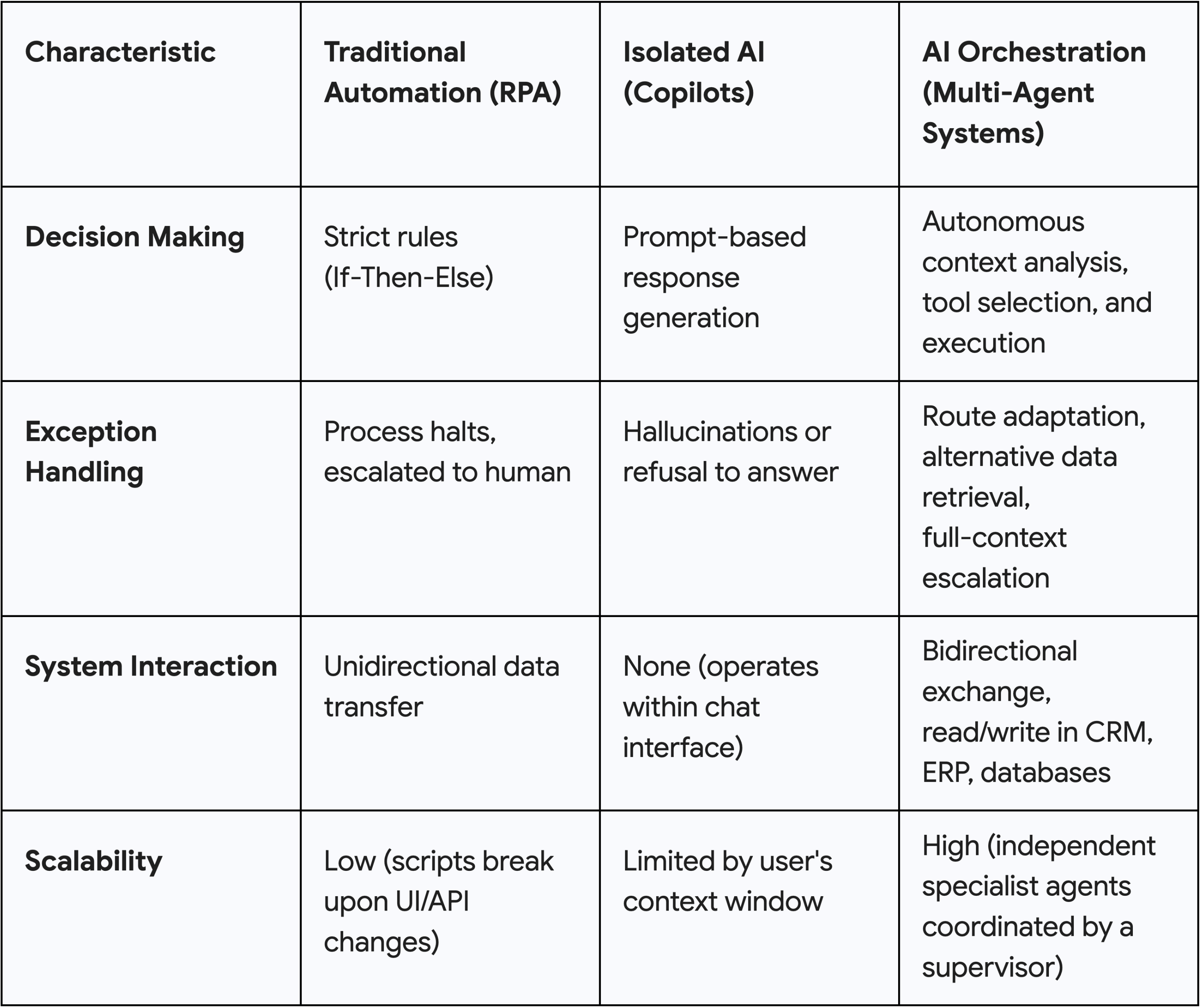
To fully grasp the dominance of Israeli companies in this sector, one must draw a clear line between traditional automation, the use of isolated AI tools, and true enterprise orchestration. This is a critical distinction consistently raised at the CTO and CIO levels, requiring a clear conceptual answer.
Traditional Robotic Process Automation (RPA) relies on rigid, rule-based scripts. These systems inevitably break down when encountering edge cases or unstructured data, requiring constant human intervention for exception handling. Conversely, early generative AI applications, while capable of understanding unstructured data, operated in isolation. They lacked the operational context necessary to execute actions within complex enterprise software environments. The implementation of such isolated tools turned intelligent agents into new digital silos, incapable of sharing information with other systems.
Enterprise-grade orchestration bridges this gap. It involves deploying a centralized operating system that coordinates the work of multiple specialized AI agents. These platforms allow agents to distribute tasks, validate data, resolve conflicts, and seamlessly interact across hundreds of integrated systems—from Customer Relationship Management (CRM) platforms to legacy Enterprise Resource Planning (ERP) software. In an orchestrated environment, a financial agent, a compliance agent, and a customer service agent do not work in isolation; they form a Unified Workforce capable of emergent collaboration.
Orchestration bridges the gap between isolated AI tools: agents no longer work in silos, they form a Unified Workforce capable of emergent collaboration.
A major fear within the corporate sector is LLM vendor lock-in. Israeli orchestration platforms, such as Mashu AI, solve this problem by implementing an LLM Abstraction Layer. This architecture allows tasks to be dynamically routed to the most appropriate CharacteristicfoTraditional Automation (RPA)unIsolated AI (Copilots)daAI Orchestration (Multi-Agent Systems)tioDecision Makingn Strict rules (If-Then-Else)moPrompt-based response generationdeAutonomous context analysis, tool selection, and execution 1l: Exception HandlingwhProcess halts, escalated to humanetHallucinations or refusal to answerheRoute adaptation, alternative data retrieval, full-context escalation 1r iSystem Interactiont'Unidirectional data transfers None (operates within chat interface)IBBidirectional exchange, read/write in CRM, ERP, databases 1M GScalabilityraLow (scripts break upon UI/API changes)niLimited by user's context windowteHigh (independent specialist agents coordinated by a supervisor) 1 for tasks requiring strict enterprise compliance, OpenAI GPT-4o for complex logical reasoning, Anthropic Claude for sensitive workflows, or locally deployed open-source models like LLaMA. Companies can switch AI providers without having to rewrite their business processes.
| Characteristic | Traditional Automation (RPA) | Isolated AI (Copilots) | AI Orchestration (Multi-Agent Systems) |
|---|---|---|---|
| Decision Making | Strict rules (If-Then-Else) | Prompt-based response generation | Autonomous context analysis, tool selection, and execution |
| Exception Handling | Process halts, escalated to human | Hallucinations or refusal to answer | Route adaptation, alternative data retrieval, full-context escalation |
| System Interaction | Unidirectional data transfers | None (operates within chat interface) | Bidirectional exchange, read/write in CRM, ERP, databases |
| Scalability | Low (scripts break upon UI/API changes) | Limited by user's context window | High (independent specialist agents coordinated by a supervisor) |
Furthermore, orchestration solves the problem of legacy infrastructure. For legacy on-premise systems lacking modern open APIs, Israeli platforms utilize secure RPA bridges and custom connectors. This enables AI agents to read, extract, and input data into older databases just as a human operator would, integrating legacy technologies into a modern ecosystem without the costly and risky need for a rip-and-replace overhaul.
The economic potential of this technology is unprecedented. The global AI orchestration market is projected to grow from approximately $.02 billion in 2025 to over $. billion by 2030, with a CAGR exceeding 22.3%. This explosive growth is driven by the acceleration of digital transformation initiatives across all major industries and the acute need for enterprises to optimize resource allocation through predictive analytics and real-time data pipeline management. However, while 72% of companies are already using some form of AI in their core operations, only 8% of enterprises have achieved full orchestration by early 2026\. This colossal gap between basic adoption and true optimization is the primary market opportunity captured by Israeli product companies.
Architectural Shifts: Infrastructure and Model Context Protocol (MCP)
Deploying autonomous multi-agent systems requires physical and software infrastructure fundamentally different from the cloud architecture of the previous decade. AI does not exist in a vacuum; it demands colossal compute power, specialized cooling, ultra-fast networks, and localized data processing. Recognizing this bottleneck, the Israeli ecosystem rapidly mobilized to build the foundational layers of the AI data center stack. Data from Grove Ventures tracks over 70 private Israeli startups that have raised over $. billion in funding directed specifically at AI infrastructure across six distinct sectors: energy, cooling, compute, storage, connectivity, and orchestration.
At the software orchestration layer, the most critical architectural event of 2026 has been the widespread enterprise adoption of the Model Context Protocol (MCP). Historically, the capabilities of AI models were limited to the knowledge embedded in their training data. If an enterprise needed an agent to check inventory levels, query a proprietary database, or update a support ticket, developers had to write fragile, custom Application Programming Interfaces (APIs) for each individual tool. MCP establishes a standardized, universal language that allows foundation models to securely query external data sources and execute actions in real-time.
Israeli tech companies, such as EGO Digital, alongside specialized security startups like Reco.ai, have played a pivotal role in adapting MCP for enterprise production environments. The protocol, first introduced by Anthropic in late 2024, solves the connectivity problem, but without strict oversight, it creates severe security vulnerabilities. Granting an autonomous agent the ability to read and write to corporate databases requires an unprecedented level of Identity and Access Management (IAM). Israeli orchestration platforms solve this challenge by embedding security at the protocol level itself.
When an AI agent operating within the Mashu AI platform connects to a system via an MCP server, it functions within strictly defined permission boundaries. MCP servers ensure environment isolation, end-to-end encryption, and centralized audit logging. Every data request, tool invocation, or response is recorded, ensuring total transparency. Startups like Reco.ai provide automated discovery of MCP usage, identifying every SaaS integration established by an AI agent, eliminating blind spots, and controlling "permission drift" as the system scales.
The architecture utilized by leading Israeli companies combines this standardized protocol with hybrid Retrieval-Augmented Generation (RAG) pipelines. Before an agent takes any action, it retrieves verified institutional knowledge from dynamically indexed databases. This ensures that the agent's responses are grounded in current, verifiable facts rather than model hallucinations. Knowledge Base Engineering relies on semantic search for conceptual queries and strict SQL search for numerical or factual data, completely eliminating the "black box" nature of traditional LLMs. By deploying edge MCP servers and stateful context management systems, these platforms reduce retrieval latency to under 100 milliseconds. This enables agents to operate at the speed required for live customer interactions and high-frequency trading environments. IBM plays a leading role in standardizing MCP at the enterprise level. The company recently released a first-of-its-kind guide, \Architecting Secure Enterprise AI Agents with MCP\, which provides a structured methodology for designing and deploying AI agents securely and at scale, addressing the fundamental challenge of integrating autonomous agents with critical business systems.
Security Paradigm Evolution: From Cyber Defense to AI Integrity
The dominance of Israeli companies in enterprise orchestration cannot be separated from the country's historical supremacy in cybersecurity and military intelligence. Transitioning from building software that defends networks to building software that acts autonomously requires a fundamental reassessment of digital trust.
In traditional cybersecurity, the perimeter is the object of defense; the goal is to prevent unauthorized external access to internal systems. In the era of agentic AI, the threat model shifts inward: the enterprise intentionally empowers internal autonomous algorithms with the authority to access sensitive data, transfer funds, and modify software code. Conventional "security" labels fail here. The problem is not just preventing a hack, but ensuring that autonomous systems act exactly as intended.
This paradigm shift has given rise to a new discipline pioneered by Israeli technologists: "AI Integrity." The cultural foundation of this approach is deeply rooted in the training methodology and operational philosophy of the Israel Defense Forces' (IDF) military and technical intelligence units, primarily Unit 8200 and the Talpiot program. Veterans of these units are trained in adversarial thinking; they design systems by proactively anticipating enemy exploitation and systemic failures.
The intense 12-day cyber conflict between Israel and Iran in June 2025 demonstrated how AI amplifies asymmetric cyber warfare. The speed at which AI-driven attacks are generated makes human reaction a critical bottleneck. The transition of cyber intelligence veterans into the civilian tech sector has ensured that security is no longer viewed as an add-on. In Israeli orchestration platforms, integrity is baked into the fundamental code through provable execution paths, cryptographic sandboxing, and interpretable decision-making matrices.
This culture has accelerated the development of AgentOps governance frameworks. Within these environments, the Human-in-the-Loop concept—where a human controls every single machine action—was recognized as an unscalable bottleneck, given the millisecond speed of modern digital operations. Consequently, Israeli platforms pioneered the "Human-on-the-Loop" supervision model.
Human-in-the-Loop was recognized as an unscalable bottleneck — Israeli platforms pioneered 'Human-on-the-Loop', where AI does the heavy lifting but execution pauses until a human clicks 'Approve.'
In this model, fleets of subordinate agents execute data retrieval, cross-referencing, and action preparation at machine speed. However, they are governed by a higher-level orchestration layer that strictly enforces predefined operational guardrails. For high-stakes, critical decisions—such as filing financial reports with the SEC or altering baseline global logistics routing—the autonomous process halts, presenting a fully contextualized summary to a human supervisor for final authorization. The AI does the heavy lifting, but execution is paused until a human clicks "Approve."
A paramount issue of trust for enterprise clients is data privacy. Israeli orchestration platforms guarantee that proprietary business information, customer data, and intellectual property are never used to train public large language models. Data processing occurs in isolated environments with zero-retention policies, ensuring full compliance with ISO 27001, SOC 2, GDPR, and HIPAA standards. Global corporations with a strong R\\&D presence in Israel are also making critical contributions to this field. IBM Research Israel developed CUGA (Configurable Generalist Agent), an advanced open-source AI agent architecture for enterprise automation. To ensure the reliability of such systems, the Israeli team also created \AgentFixer\, a comprehensive validation framework for diagnosing and preventing failures in multi-agent architectures. In response to the enterprise need for strict control over autonomous systems, IBM released a major update to watsonx.governance (version 2..x) specifically targeted at agentic AI. This system now includes agent inventory management, behavior monitoring, decision evaluation, and emergency technical controls like kill switches.
Industry Orchestration: Practical Cases of Israeli Leadership
The theoretical advantages of multi-agent orchestration are most vividly demonstrated in highly regulated and complex industry verticals. Israeli tech companies, such as EGO Digital, specialize in building cognitive foundations for sectors where the cost of failure is catastrophic, transforming theoretical algorithms into measurable operational advantages. EGO Digital's product ecosystem, which includes Mashu AI, ETGAR, Shipper Global, and NeuroLab, serves as the perfect embodiment of the "Clarity Before Code" principle in real-world market conditions.
Mashu AI: The Operating System for Intelligent Agents
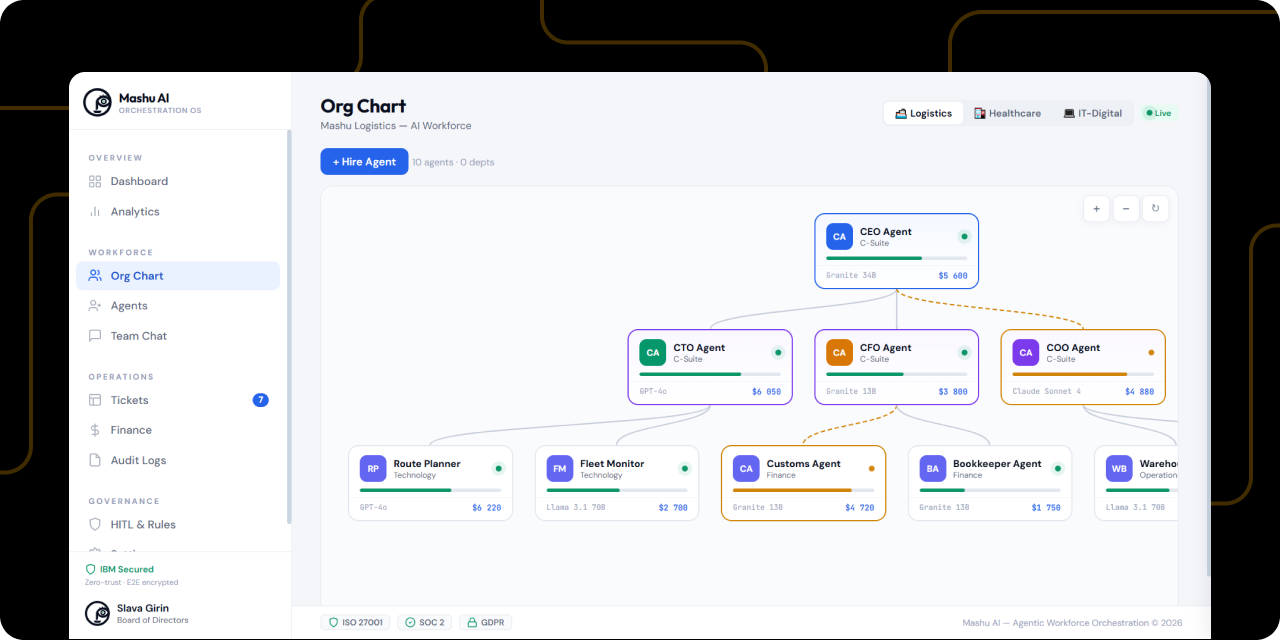
Mashu AI acts as the central orchestration layer—an enterprise-grade operating system that unites isolated AI tools into a single secure ecosystem. The platform allows organizations to design, deploy, and manage intelligent agents, automating complex business processes under complete human oversight.
A defining feature of Mashu AI is its integration capability. The system connects to over 700 enterprise tools—from Salesforce and SAP to custom ERP systems—and works with any AI model thanks to its LLM Abstraction Layer. The Supervisor Agent architecture intelligently distributes tasks among specialized agents, allowing them to share context (via the Agent-to-Agent protocol) and collaboratively solve complex, multi-step problems. Built on IBM Cloud infrastructure, Mashu AI provides bank-level security, offering a full AgentOps management lifecycle: from visual design (Langflow Visual Builder) to continuous performance monitoring and the real-time application of security policies.
Financial Services and Regulatory Compliance: ETGAR Platform
The financial sector faces an exponentially growing burden of regulatory reporting. In the US, starting March 18, 2026, directors and officers of Foreign Private Issuers (FPIs) are required to file Forms 3, 4, and 5 with the Securities and Exchange Commission (SEC) to disclose beneficial ownership. New SEC requirements, alongside the implementation of the EDGAR Next system, introduce tighter compliance timelines and heightened scrutiny. Traditional document management tools merely organize the chaos of versioning but fail to understand the underlying financial data, creating a risk of regulatory penalties.
ETGAR is an EGO Digital platform solution developed specifically for automating regulatory documentation (RegTech) in financial markets. The platform functions as a fully AI-native regulatory ecosystem. Instead of relying on analysts to copy and paste data, specialized extraction agents connect directly to ERP systems to retrieve real-time financial metrics. Validation agents autonomously compare these figures against historical baselines, instantly flagging anomalies for human review.
A critical advantage of ETGAR is automated XBRL (eXtensible Business Reporting Language) tagging. AI agents analyze document structure and financial content, contextually apply the correct XBRL taxonomy tags, and generate submission-ready files for the SEC. This sequential agent orchestration delivers a 90% reduction in document drafting time, guarantees 100% automated XBRL tagging, and entirely eliminates version conflicts (Zero Version Conflicts).
Global Logistics and Supply Chain Resilience: Shipper Global Platform
Global shipping is a bureaucratic labyrinth of international customs regulations, fluctuating carrier rates, and fragmented e-commerce integrations. The introduction of stringent customs rules by the European Union, specifically the Import Control System 2 (ICS2) Release 3, fundamentally altered the compliance landscape in 2026\. ICS2 Release 3 mandates the submission of a detailed electronic Entry Summary Declaration (ENS) prior to the arrival of goods in the EU, Northern Ireland, Norway, or Switzerland. This includes the mandatory provision of a minimum six-digit Harmonized System (HS) code for each product and a precise cargo description.
Traditional logistics software lacks the predictive intelligence required to manage this complexity at scale. The Shipper Global platform functions as an autonomous logistics operating system, bridging the gap between digital storefronts (Shopify, WooCommerce, Magento) and physical carrier networks.
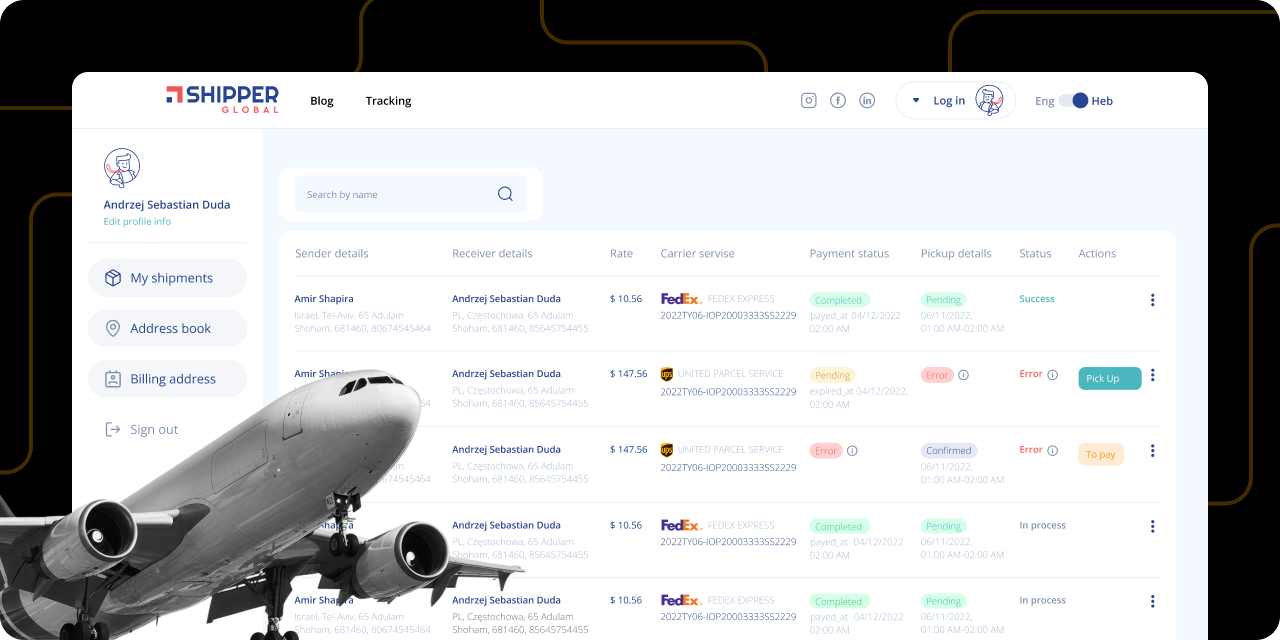
Leveraging multi-agent orchestration, Shipper Global automatically extracts order data, applies machine learning models to assign highly accurate HS codes (with over 95% accuracy in milliseconds) across 15+ languages, and calculates exact taxes and duties (DDP/DDU) for more than 220 countries. The platform integrates via API with global carriers such as DHL, FedEx, UPS, and Aramex, comparing rates and reliability in real-time. This orchestrated approach achieves over 90% end-to-end workflow automation and 100% automated customs clearance, radically reducing the risk of rejections at the European border and slashing logistics costs by 60%.
Healthcare and Remote Patient Monitoring: NeuroLab Platform

In the healthcare sector, the transition from episodic clinical visits to continuous remote patient monitoring presents a colossal data management challenge. When patients (especially the elderly) leave a medical facility, a "visibility gap" emerges, where missed medications or hidden deteriorations go unnoticed until a critical emergency strikes. Passive patient portals suffer from chronically low engagement rates.
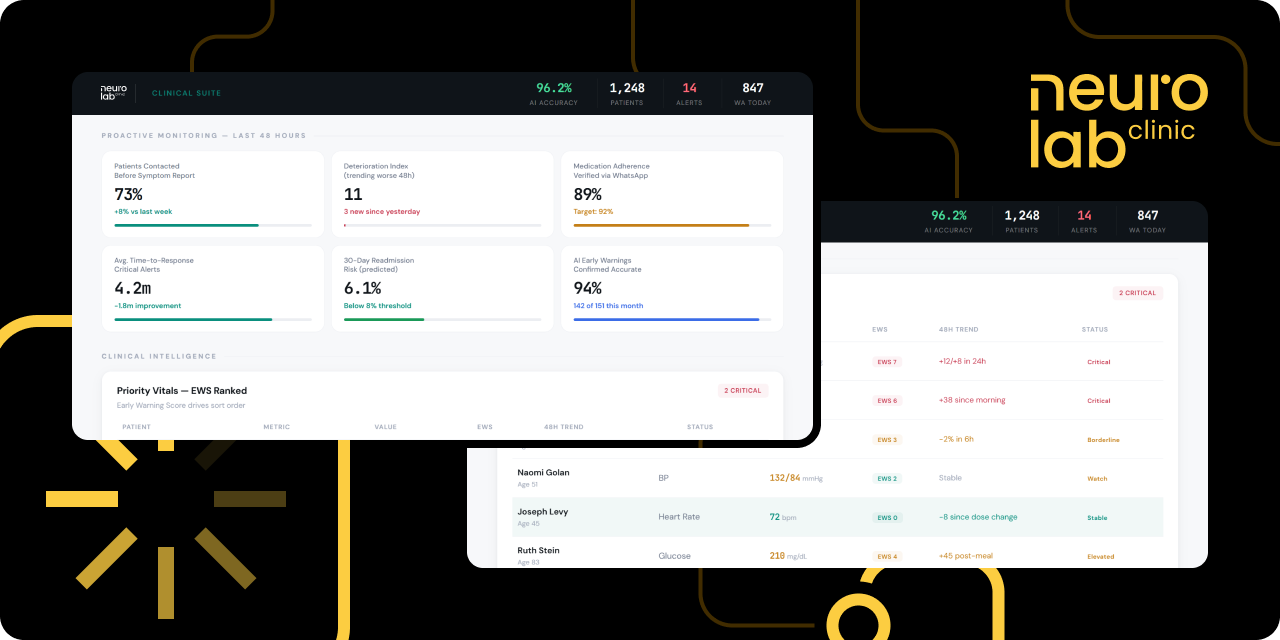
The NeuroLab orchestration platform solves this problem by deploying proactive, voice-first multi-agent systems. Conversational agents initiate contact with patients through natural phone calls or messages, adapting dynamically to patient responses. Speech-to-text agents securely process this unstructured, multilingual conversational dialogue into structured clinical data. Simultaneously, anomaly detection agents cross-reference incoming data against the patient's historical baseline. If a critical deviation is detected (e.g., a report of pain or persistent non-response), the orchestration layer automatically escalates an alert to medical staff in under 5 minutes. To prevent physician burnout, summarization agents synthesize raw data into concise clinical reports. NeuroLab ensures 100% coverage of post-clinical blind spots and achieves 95% medication adherence, functioning in strict compliance with HIPAA requirements for encrypting voice and medical data.
Market Dynamics and Scaling Strategy of Israeli Companies
The global AI race is intensifying. While Silicon Valley and tech giants (OpenAI, Anthropic, Microsoft, Google) concentrate massive volumes of capital ($10–60+ billion rounds) on building frontier AI models 31, Israeli companies have chosen a different, highly efficient trajectory. They are not competing in the race to build the largest language model; they are competing in architecture, operational efficiency, and the application of models to solve specific industry challenges.32
Investment dynamics in early 2026 validate the success of this approach. Israeli startups focused on orchestration, agent security, and applied AI are securing significant funding rounds: Qodo raised $70M (Series B) to tackle AI code quality, Sett secured $30M to automate game marketing with AI agents, Notch raised $30M to automate customer experience, and Upwind reached a $. billion valuation with an investment from Salesforce Ventures.33 A striking example of efficiency is Above Security, which raised $43-50M with just 10 employees, perfectly illustrating the "lean sovereign" concept and the breaking of the correlation between headcount and business scale.
In this competitive landscape, EGO Digital's "Ready \+ Custom" approach solves the ultimate enterprise software dilemma. Historically, CIOs faced a choice: buy a rigid SaaS product that forces the company to mold its processes to software constraints, or embark on a risky, multi-year project to build an AI ecosystem from scratch. The "Ready \+ Custom" approach offers the best of both worlds: the core orchestration system (including supervisor architecture, MCP servers, API gateways, and security logging) is provided via the robust Mashu AI platform, accounting for about 70% of the final solution. The remaining 30% is custom-developed, embedding the specific business rules, proprietary data models, and unique regulatory requirements of the individual enterprise. This reduces the implementation cycle from years to just 12- weeks for a full enterprise rollout (and 6- weeks for a pilot project).
The capability for rapid deployment depends critically on strategic partnerships with global tech infrastructure providers. EGO Digital's partnership with IBM serves as a model of such synergy. As a Platinum Business Technology Partner, EGO Digital deploys its orchestration platforms directly within the most secure, protected cloud infrastructures available globally (IBM Cloud, watsonx). In this paradigm, IBM provides the "secure engine" (scalable cloud computing, military-grade encryption, IBM Granite foundation models), while EGO Digital builds the "vehicle" (Mashu AI)—a complex orchestration system that channels this power to solve tangible business challenges. To scale the multi-agent orchestration ecosystem, IBM has forged a series of critical strategic alliances. A partnership with Groq provides ultra-fast and cost-effective inference for agents in regulated industries. Integration with ElevenLabs gives agents natural, multilingual voice capabilities for richer conversational experiences. Furthermore, collaboration with S\\&P Global embeds multi-agent orchestration into the management of complex global supply chains and procurement.
Regulatory Compliance as a Competitive Advantage
As Israeli tech companies aggressively expand into US and European markets in 2026, their success increasingly hinges on their ability to navigate a rapidly tightening global regulatory environment. The legal landscape has shifted from theoretical guidelines to strict enforcement practices. In Europe, the implementation of the AI Act and the NIS2 Directive—which expands cybersecurity obligations to supply chains—is in full swing. In the US, the SEC has bolstered cyber risk disclosure rules and is rolling out EDGAR Next requirements.
The NIS2 Directive requires European organizations to exert unprecedented control over their digital supply chains. If an enterprise integrates an AI agent that has access to its core network, that agent and its provider fall under intense regulatory scrutiny. Moreover, the EU's emphasis on transparent, risk-aware AI deployment demands systems capable of explaining decision-making processes and providing immutable audit trails.34
Israeli orchestration platforms, grounded in the "Evidence Over Intuition" principles, view the concept of "compliance-by-design" not as an administrative burden, but as their primary competitive advantage. By ensuring that every action of an autonomous agent is logged, timestamped, and linked to a specific user or authorization protocol, these platforms provide the exact evidentiary base demanded by European regulators and American auditors.
International integration is catalyzed by the Israeli import and standardization reform, known under the banner "What's Good for Europe is Good for Israel."35 This reform, continuing its rollout through 2028, aligns the Israeli regulatory framework with European directives, dismantling bureaucratic barriers.35 A similar Amendment No. 21 to the Standards Law aims to harmonize with US federal legislation.35 Such macroeconomic and legal convergence creates an ideal environment for scaling Israeli tech: a product built and tested to comply with stringent data protection rules (Privacy Protection Law guidelines on AI) in Israel 36 is, by default, ready for integration into highly regulated EU and US markets.
Conclusion
The ascent of Israeli tech companies to leadership positions in enterprise AI orchestration is not merely a matter of lucky market timing; it is the result of a profound structural alignment between technological capabilities and global business needs. The global corporate market has outgrown its fascination with simple generative chatbots. Today, enterprises demand highly secure, autonomous systems capable of coordinating fleets of applications, databases, and legacy systems without human intervention, making decisions at machine speed.
The Israeli ecosystem—hardened by conditions that demand extreme resilience, possessing deep expertise in offensive and defensive cybersecurity, and backed by robust state support—is uniquely prepared to build the infrastructure of this new era. Companies like EGO Digital do not simply implement algorithms; they are rewiring the fundamental architecture of corporate operations, anchored by the "Clarity Before Code" philosophy.
By successfully navigating the transition from generative models to agentic orchestration, standardizing the secure use of the Model Context Protocol (MCP), and elevating cybersecurity to the level of "AI Integrity," Israeli platforms are forging the central nervous system of global corporations. In an environment where macroeconomic pressures dictate the need for non-linear productivity gains without headcount expansion, the orchestration systems engineered in Israel today will define the operational efficiency, regulatory compliance, and competitive survival of global enterprises through 2030 and well beyond. Organizations investing in orchestration today are not just automating chaos; they are engineering the intelligence that will serve as the foundation of their future leadership.
Reference List:
- The Israeli Agentic AI Landscape \- Twine Security, accessed April 5, 2026, The Israeli Agentic AI Landscape - Twine Security, accessed April 5, 2026, https://www.twinesecurity.com/resource/the-israeli-agentic-ai-landscape
- "Israel's next growth chapter will be built on critical systems the world ..., accessed April 5, 2026, https://www.calcalistech.com/ctechnews/article/3et09oqf4
- 5 Trends to Watch in 2025: AI and the Israeli Market | Insights | Greenberg Traurig LLP, accessed April 5, 2026, https://www.gtlaw.com/en/insights/2025/1/published-articles/5-trends-to-watch-2025-ai-and-the-israeli-market|---|
- The AI startup nation: Meet five organizations that show how Israel continues to lead in new technologies - Google Cloud, accessed April 5, 2026, https://cloud.google.com/transform/israel-ai-startups-roundup-gen-ai-challenges-opportunities-leadership
- Israel Innovation Authority 2025 High-Tech Report - English ..., accessed April 5, 2026, https://innovationisrael.org.il/en/press_release/innovation-report-2025/
- The Government Has Decided on the Establishment of a National Artificial Intelligence Headquarters – A Strategic Move for the Future of Israel's Economy and Security - Gov.il, accessed April 5, 2026, https://www.gov.il/en/pages/press_21092025a
- National Program for Artificial Intelligence - OECD.AI, accessed April 5, 2026, https://oecd.ai/en/dashboards/policy-initiatives/national-program-for-artificial-intelligence-4541
- The Israeli National AI Program - artificial intelligence, accessed April 5, 2026, https://aiisrael.org.il/
- Joint Statement of the United States and Israel on the Launch of a Strategic Partnership on Artificial Intelligence, Research, and Critical Technologies, accessed April 5, 2026, https://www.state.gov/releases/office-of-the-spokesperson/2026/01/joint-statement-of-the-united-states-and-israel-on-the-launch-of-a-strategic-partnership-on-artificial-intelligence-research-and-critical-technologies
- Israel and the US sign a Joint Statement launching a strategic partnership on AI, research and critical technologies - Gov.il, accessed April 5, 2026, https://www.gov.il/en/pages/israel-us-strategic-partnership-on-ai-research-and-critical-technologies-16-jan-2026
- The Five Stages of AI Agent Evolution - NFX, accessed April 5, 2026, https://www.nfx.com/post/ai-agent-revolution
- AI Orchestration Market Report 2026 - Research and Markets, accessed April 5, 2026, https://www.researchandmarkets.com/reports/6226642/ai-orchestration-market-report
- AI Orchestration Market Report 2025-2030, by Application, Geo, Tech - MarketsandMarkets, accessed April 5, 2026, https://www.marketsandmarkets.com/Market-Reports/ai-orchestration-market-148121911.html
- Artificial Intelligence (AI) Orchestration Global Market Report 2026, accessed April 5, 2026, https://www.giiresearch.com/report/tbrc1970095-artificial-intelligence-ai-orchestration-global.html
- Israeli Startup Ecosystem Map - Grove Ventures, accessed April 5, 2026, https://www.grovevc.com/insights/news/data-center-infrastructure-israeli-startup-ecosystem-map/
- Data Center Infrastructure: Israeli Startup Ecosystem Map - Grove Ventures, accessed April 5, 2026, https://www.grovevc.com/israeli-startup-ecosystem-map/
- Model Context Protocol (MCP) Is Rewiring SaaS Trust, One Agent Action at a Time - Reco, accessed April 5, 2026, https://www.reco.ai/blog/model-context-protocol-mcp-is-rewiring-saas-trust-one-agent-action-at-a-time
- MCP's biggest growing pains for production use will soon be solved - The New Stack, accessed April 5, 2026, https://thenewstack.io/model-context-protocol-roadmap-2026/
- Microsoft partners with Anthropic to create official C# SDK for Model Context Protocol, accessed April 5, 2026, https://developer.microsoft.com/blog/microsoft-partners-with-anthropic-to-create-official-c-sdk-for-model-context-protocol
- The next wave of AI Is more than just models, accessed April 5, 2026, https://www.otpp.com/en-ca/about-us/news-and-insights/global-perspectives/the-next-wave-of-ai-is-more-than-just-models/
- Mapping Israel's AI infrastructure opportunity - CTech, accessed April 5, 2026, https://www.calcalistech.com/ctechnews/article/b1qdiprv11l
- Trend Analysis The Israeli Unit 8200 An OSINT-based study CSS CYBER DEFENSE PROJECT - CSS ETH Zürich, accessed April 5, 2026, https://css.ethz.ch/content/dam/ethz/special-interest/gess/cis/center-for-securities-studies/pdfs/Cyber-Reports-2019-12-Unit-8200.pdf
- AI and the Evolution of Asymmetric Cyber Warfare: Insights from the 2025 Israel-Iran Conflict, accessed April 5, 2026, https://trendsresearch.org/insight/ai-and-the-evolution-of-asymmetric-cyber-warfare-insights-from-the-2025-israel-iran-conflict/
- Israel Group News - January 2026 | DLA Piper, accessed April 5, 2026, https://www.dlapiper.com/insights/publications/israel-group-news/2026/01/israel-group-news-january-2026
- Resilience Under Fire: Israeli Tech Companies Navigate the New Washington - Legal 500, accessed April 5, 2026, https://www.legal500.com/doing-business-in/resilience-under-fire-israeli-tech-companies-navigate-the-new-washington/
- EU Customs Rules 2026: ICS2, CBAM, and ESG — The New Regulatory Reality for International Trade | SeaRates Blog, accessed April 5, 2026, https://www.searates.com/blog/post/eu-customs-rules-2026-ics2-cbam
- Mastering ICS2: A Guide to EU Import Requirements - iCustoms, accessed April 5, 2026, https://www.icustoms.ai/blogs/mastering-ics2-guide-eu-import-requirements/
- ICS2 release 3: how to prepare for key compliance changes - CargoWise, accessed April 5, 2026, https://www.cargowise.com/es-la/news/ics2-release-3-how-to-prepare-for-key-compliance-changes/
- An ICS2 Release 3 update for businesses selling in the EU - Avalara, accessed April 5, 2026, https://www.avalara.com/blog/en/europe/2024/03/ics2-release-3-update.html
- Enterprise AI Companies: Landscape Breakdown in 2026 - AIMultiple, accessed April 5, 2026, https://aimultiple.com/enterprise-ai-companies
- How Israeli tech entered a mature era in 2025 | The Jerusalem Post, accessed April 5, 2026, https://www.jpost.com/jerusalem-report/article-884771
- Full list of Israeli high-tech funding rounds in 2026 | Ctech, accessed April 5, 2026, https://www.calcalistech.com/ctechnews/article/rq8lzbs4c
- IAPP Global Legislative Predictions 2026, accessed April 5, 2026, https://iapp.org/resources/article/global-legislative-predictions
- "What's Good for Europe Is Good for Israel": Q&A Reviewing the Import Reform One Year In, accessed April 5, 2026, https://www.complianceandrisks.com/blog/whats-good-for-europe-is-good-for-israel-qa-reviewing-the-import-reform-one-year-in/
AI Watch: Global regulatory tracker - Israel | White & Case LLP, accessed April 5, 2026, https://www.whitecase.com/insight-our-thinking/ai-watch-global-regulatory-tracker-israel
Ready to Explore Enterprise AI Orchestration for Your Business?
The patterns described in this report are not theoretical — they reflect the real-world architectures we design and deploy at EGO Digital every day, for clients ranging from global logistics leaders to financial institutions.
If you are evaluating AI orchestration for your enterprise, or looking for a technology partner who understands both the strategic and technical dimensions of this shift, we would be glad to talk.
Do you have any questions about AI Orchestration & Multi-Agent Systems?
Ask Slava Girin – CEO, Partner!
Since 2011, I’ve been helping leaders at companies like IBM, Matrix, Coca Cola, Isracard, Tollmans, FedEx, Wix and El Al move from "AI chaos" to structured Enterprise Orchestration. I’m a firm believer in Clarity Before Code — because technology only works when the strategy is sound. If you’re wondering how to implement AI without the guesswork, I’d love to help. Let’s explore your next step together.
Recent Articles

Your AI Is Quietly Moving Your Data Across Borders
In the age of AI, data sovereignty is about control — not location.

Observability and Analytics: You Can't Deploy an Agent You Can't See
An autonomous agent in a demo looks like magic. The same agent in production, three weeks later, is often quietly pulled back out. The gap between those two moments is almost never the model. It is whether anyone could actually see what the agent was doing.

Your Next Competitor Has No Capital
Every few weeks, someone asks me whether AI is a bubble. Usually it's a sharp person — an investor, a board member, a fellow founder — and they ask while glancing at a stock chart that has gone vertical. It's a fair question. It's also aimed at the wrong object.
THE FUTURE IS AI-NATIVE.
LET'S BUILD IT WITH YOU.
Partner with us to design and deploy AI-native systems.