Building the Foundation for Intelligent Retrieval.

Knowledge Base Engineering

Transform your data into answers your AI can trust.
Knowledge Base Engineering
Trusted by global partners, startups and enterprises

AI is only as good as the knowledge it can access

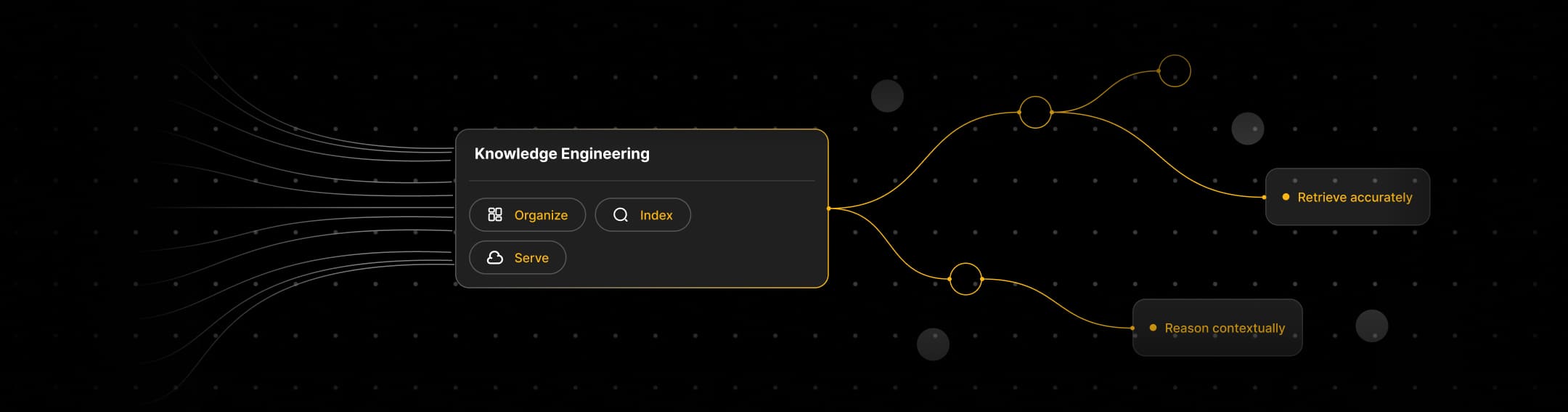
We engineer dynamic knowledge systems that organize, index and serve your institutional knowledge — enabling AI agents to retrieve accurately, reason contextually and cite transparently.

IBM
No more AI hallucinations. No more 'I don't have that information.' Just traceable, explainable answers powered by hybrid RAG pipelines and secured by IBM technology.

Why It Matters

Your data exists. Your AI just can't find it.
Most organizations sit on vast knowledge assets — documents, policies, manuals, contracts, databases, emails, wikis. But when employees or AI systems need answers, that knowledge is hard to retrieve.
  • Scattered across dozens of systems and formats.
  • Unstructured in ways that search can't penetrate.
  • Outdated without clear versioning or ownership.
  • Inaccessible to AI agents that need real-time retrieval.

Knowledge Base Engineering solves this:

  • Unified knowledge layer that connects all your information sources.
  • Intelligent indexing that understands meaning, not just keywords.
  • RAG pipelines that retrieve the right context for every AI query.
  • Traceable citations so you always know where answers came from.

The difference between AI that guesses and AI that knows is engineering.

Our Approach

We build knowledge infrastructure using a principle we call Retrieval-First Intelligence — where AI accuracy starts with what it can access, not what it can generate.

Three pillars define our methodology:

Structure Before Scale

We don't just dump documents into a vector database. We analyze your knowledge architecture, define taxonomies, establish relationships and create retrieval-optimized structures before indexing begins.

Hybrid RAG Pipelines

We combine multiple retrieval methods (semantic search, keyword matching, knowledge graphs, structured queries) to maximize accuracy and minimize hallucination. Different questions need different retrieval strategies.

Living Knowledge Systems

Knowledge bases aren't static. We build pipelines for continuous ingestion, version control, quality monitoring and automatic updates — so your AI always accesses current, accurate information.

Industries Using Knowledge Base Engineering

Financial Services · Legal · Healthcare · Insurance · Manufacturing · Government
Financial Services
Legal
Healthcare
Insurance
Manufacturing
Government
Primary KPI
90
%

reduction in information retrieval time

ZEROhallucination

policy through retrieval-grounded responses

95+%

answer accuracy with proper citations

80%

decrease in "knowledge not found" failures

100% audit trail

for compliance and governance

Key Capabilities

Knowledge Architecture Design

Knowledge Architecture Design

We analyze your information landscape and design optimal structures — taxonomies, ontologies, metadata schemas and relationship maps that make retrieval precise and scalable.Example: Mapping a financial institution's regulatory knowledge across 15 document types, 200+ regulations and 50 jurisdictions into a unified queryable structure.

Document Processing & Enrichment

Document Processing & Enrichment

We transform unstructured documents into AI-ready knowledge — extracting entities, relationships, tables and hierarchies while preserving context and provenance.Example: Converting 2,000+ internal policy documents into structured knowledge objects with automatic categorization, cross-referencing and change tracking.

Hybrid RAG Pipeline Development

Hybrid RAG Pipeline Development

We build retrieval systems that combine semantic search, keyword matching, knowledge graphs and SQL queries — selecting the optimal strategy for each question type.Example: Legal research system that uses semantic search for concept queries, exact matching for citation lookups and graph traversal for precedent chains.

Knowledge Graph Construction

Knowledge Graph Construction

We create connected knowledge representations where entities, relationships and attributes form queryable networks — enabling AI to reason across your information, not just retrieve it.Example: Product knowledge graph connecting specifications, compatibility rules, troubleshooting steps and customer feedback — powering support agents with complete context.

Multi-Source Integration

Multi-Source Integration

We connect diverse knowledge sources — documents, databases, APIs, wikis, emails, CRMs — into unified retrieval layers without requiring migration or duplication.Example: Enterprise knowledge base pulling from SharePoint, Confluence, Salesforce and legacy databases through a single query interface.

Citation & Explainability Layer

Citation & Explainability Layer

We implement transparent sourcing for every AI response — showing exactly which documents, sections and versions informed each answer, with confidence scores and alternative sources.Example: Compliance assistant that answers questions with direct citations to specific policy paragraphs, including document version and last update date.

Expert Playbook

When to Use

When to Use

  • AI agents giving inconsistent or incorrect answers due to poor knowledge access.
  • Critical information scattered across multiple systems and formats.
  • Compliance or legal requirements demanding traceable, auditable AI responses.
  • Employees spending hours searching for information that exists somewhere.
  • Scaling expertise — making specialist knowledge available organization-wide.

Not a Fit If

Not a Fit If

  • Knowledge doesn't exist yet (create content before engineering retrieval).
  • Information changes faster than it can be indexed (real-time APIs better).
  • Single, simple data source that doesn't need complex retrieval.
  • No AI or automation use case for the knowledge (solve the "why" first).

Architecture Choices

Vector Database + Semantic Search

Vector Database + Semantic Search

Best for: conceptual queries, document similarity, exploratory questions.

Knowledge Graph + Graph Queries

Knowledge Graph + Graph Queries

Best for: relationship questions, multi-hop reasoning, connected information.

Hybrid RAG

Hybrid RAG

Best for: production systems requiring high accuracy across diverse query types.

Structured Database + SQL

Structured Database + SQL

Best for: factual lookups, numerical queries, transactional data.

Implementation Path

Discover2–3 weeks

Audit knowledge sources, analyze query patterns, define retrieval requirements

Design2–4 weeks

Create knowledge architecture, taxonomies, and pipeline specifications

Build4–6 weeks

Process documents, build indexes, develop RAG pipelines, implement citation layer

Deploy & Evolveongoing

Launch with monitoring, measure accuracy, continuously improve retrieval

Field Notes

Real World Evidence
100 % automated XBRL tagging
ETGAR (Financial Services)
Transformed 2,000+ internal policy documents into a dynamic knowledge graph powering compliance AI agents. Documents automatically parsed, cross-referenced and version-controlled. Result: 90% reduction in regulatory drafting time and 100% automated XBRL tagging with full citation trails.
220 + countries
Shipper Global (Logistics)
Built a comprehensive knowledge base covering customs regulations, HS code classifications, tax rules and carrier requirements across 220+ countries. AI agents query this knowledge in real-time to generate compliant documentation — achieving 100% automated customs processing with zero manual lookups.
95 %
NeuroLab (Healthcare)
Engineered a medical knowledge system integrating treatment protocols, medication databases and patient history into a unified retrieval layer. Supports HIPAA-compliant AI assistants that provide accurate clinical information with proper sourcing — enabling 95% medication adherence through informed patient communication.
50,000 + docs
Enterprise Legal (Confidential)
Created a precedent knowledge base from 50,000+ case documents with relationship mapping between rulings, statutes and legal concepts. Lawyers now retrieve relevant precedents in seconds instead of hours — with automatic citation formatting and relevance scoring.

Security & Compliance

GDPR, ISO 27001, HIPAA Compliant
Secured by IBM Technology
Data classification — automatic sensitivity tagging and access control based on content
Encryption at rest and in transit — all knowledge assets protected end-to-end
Access-controlled retrieval — AI agents only access knowledge they're authorized to see
Audit logging — every query, retrieval and citation tracked for compliance
Enterprise standards — ISO 27001, SOC 2, GDPR, HIPAA compliant infrastructure

Frequently asked questions

Let's build the knowledge foundation that makes intelligence possible.

Your AI should know what your organization knows.
CTA
CTA